Why Medicare Retention Fails After Enrollment (And What Agencies Can Do About It)
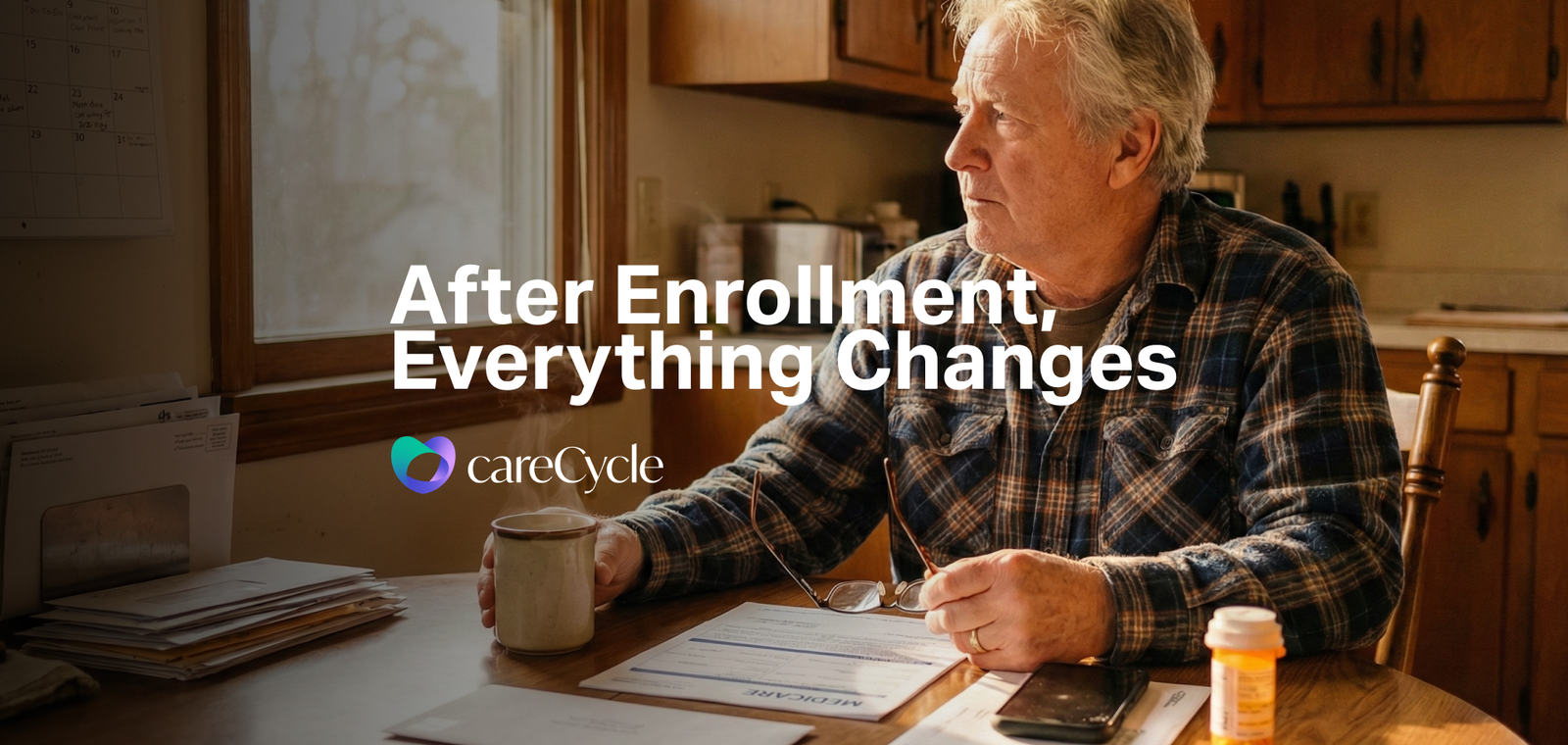
careCycle exists for a simple reason: Medicare agencies lose members after enrollment, and most don’t realize it until it’s too late.
Not because their agents are underperforming.
Not because their sales process is broken.
But because once enrollment is complete, almost nothing meaningful happens next.
Retention doesn’t fail at renewal.
It fails in the quiet months after enrollment, when questions go unanswered, confusion compounds, and trust slowly erodes.
The Moment Most Systems Shut Off
Most Medicare infrastructure is built around events: lead intake, enrollment, AEP. Once the application is submitted, the system relaxes. A welcome packet is sent. An onboarding email goes out. The assumption is that stability follows until renewal.
careCycle was built after analyzing real post-enrollment behavior across nearly one million Medicare conversations and realizing that assumption is wrong.
Members don’t stop needing help after enrollment. In many cases, that’s when questions actually begin.
Prescription coverage confusion. Provider access. Billing issues. Benefit interpretation. Changes in health status. These aren’t exceptions. They’re the day-to-day reality of being a Medicare beneficiary.
And critically, a meaningful share of these moments happen:
- After hours
- Outside scripted flows
- Under emotional stress
This is where retention is actually decided.
Why Most Medicare Retention Programs Don’t Adapt
Most retention programs are static by design.
They rely on scheduled outreach instead of real-time demand.
Scripts instead of context.
CRMs that store notes but never surface patterns.
Human agents repeatedly solving the same problems in isolation.
From the outside, it looks like effort.
From the inside, it’s stagnation.
The same questions show up month after month. The same confusion resurfaces every AEP. The same issues reach human agents again and again. But the system never improves, because it has no mechanism to learn from what’s happening at scale.
careCycle was designed specifically to close that gap.
Retention Isn’t About More Touchpoints. It’s About Learning.
The most common mistake agencies make is assuming retention improves with volume: more calls, more check-ins, more campaigns.
In reality, retention improves with feedback loops.
When we looked across hundreds of thousands of post-enrollment conversations, the strongest outcomes didn’t come from agencies working harder. They came from systems that observed patterns, adapted workflows, and improved with every interaction.
Every repeated question is a signal.
Every escalation reveals friction.
Every confused caller points to something upstream that can be fixed.
careCycle treats post-enrollment conversations as intelligence, not noise.
Why Voice Is the Missing Layer in Medicare Retention
Post-enrollment Medicare conversations are rarely clean or predictable. Members change topics mid-sentence. They interrupt themselves. They express frustration without stating it directly.
Voice captures what structured systems miss:
- Tone and hesitation
- Emotional escalation
- Repeated confusion across different members
- Where conversations break down, not just where they end
This matters because Medicare retention is emotional before it is transactional.
When voice systems are designed properly, members don’t disengage when they realize they’re speaking to AI. In fact, many express appreciation mid-conversation and complete interactions naturally without requesting a human transfer.
That doesn’t happen in systems that feel robotic or transactional. It happens when voice is used to support, not deflect.
careCycle’s voice layer is built for this reality. It handles routine questions, escalates intelligently, preserves full context, and feeds what it learns back into the system so the next interaction is better than the last.
Static Retention Programs vs Learning Systems
Most Medicare retention programs ask:
- Was the member contacted?
- Did someone answer the call?
- Was the issue closed?
careCycle asks different questions:
- Why did this issue arise in the first place?
- How often is it happening across the book?
- Should this be automated, clarified, or prevented entirely?
- What should change before the next member calls?
That difference compounds over time.
Instead of agents repeatedly solving the same problems, the system improves upstream. Instead of entering every AEP scrambling to replace lost members, agencies show up with a healthier, more engaged book.
In production deployments, AI-human hybrid workflows consistently resolve complex Medicare inquiries while preserving compliance and escalation controls. The result isn’t fewer agents. It’s more capacity, less burnout, and better member experiences at scale.
Why careCycle Focuses on Post-Enrollment
careCycle supports the entire Medicare lifecycle, from first conversation through renewal. That includes sales. Enrollment matters. Getting the decision right matters.
But where most systems stop at the close, careCycle keeps working.
The reality of Medicare is that sales is an event. Retention is a system.
Once enrollment is complete, the questions start. Benefits get used. Prescriptions change. Providers matter. Life happens. These moments rarely show up in sales dashboards, but they ultimately determine whether a member stays, disengages, or leaves at renewal.
That’s why careCycle is built to extend beyond enrollment and into the long middle — the months where trust is either reinforced or quietly lost.
AI in this context isn’t about replacing agents or automating away relationships. It’s about supporting them across the full lifecycle. Absorbing routine demand. Preserving context between conversations. Making sure licensed agents step in with clarity, not cold starts.
Sales opens the relationship.
Post-enrollment determines its value.
By treating enrollment and retention as one continuous system — not disconnected workflows — careCycle helps agencies scale both growth and longevity without breaking their teams.
That’s how Medicare books compound instead of resetting every October.
Retention Is a System, Not a Campaign
Agencies don’t rebuild their book every October because Medicare is seasonal. They rebuild because nothing compounds the rest of the year.
If your post-enrollment system doesn’t learn, retention flatlines.
If every conversation makes the system smarter, retention compounds.
That’s the shift careCycle was built to enable.
And it’s why agencies that stop treating retention like a renewal problem start seeing it for what it really is: an infrastructure advantage.